

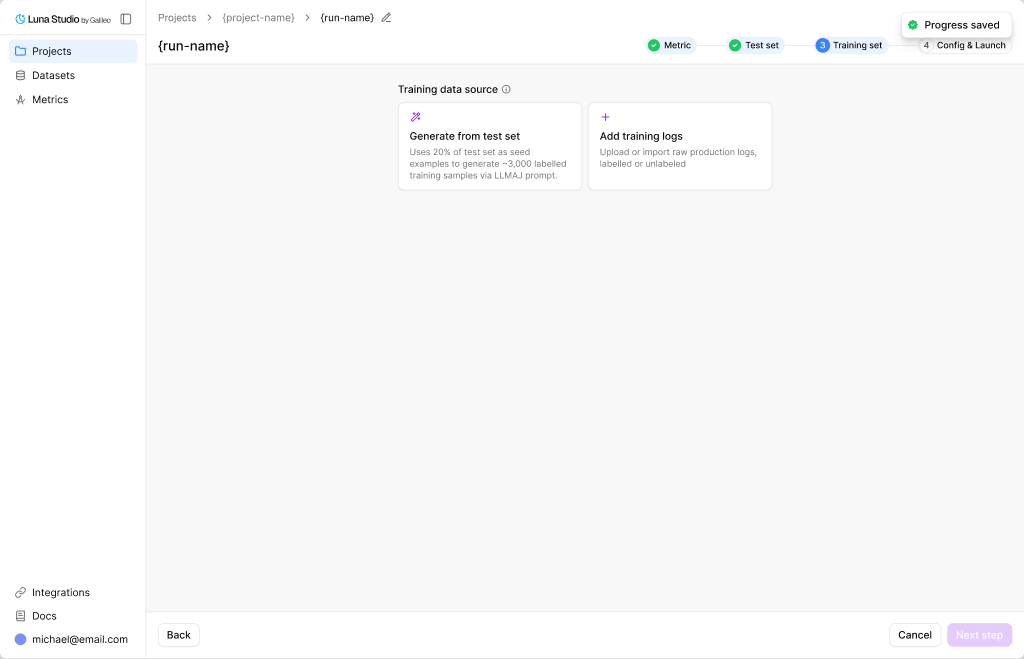
Step 3 — pick a training data source: generate, add logs, or use an existing training set
The three training dataset sources
The step opens with a section heading Training data source and three selectable cards:Generate from test set
Uses 20% of your test set as seed examples to generate 2,000 labelled training examples. Recommended for first runs.
Add training logs
Upload or import your own raw production logs. If they are unlabelled, Luna Studio labels them before training.
Use existing training set
Reuse a previously generated, labelled, or uploaded training dataset from your workspace.
Generate from test set
This option creates a training set from your test set in three steps:- Configure generation and generate a sample dataset
- Review 50 sample rows and provide feedback to the generator
- Generate the final 2,000-example dataset once you are happy with the samples
Configure the generator
Configure generation with the following settings: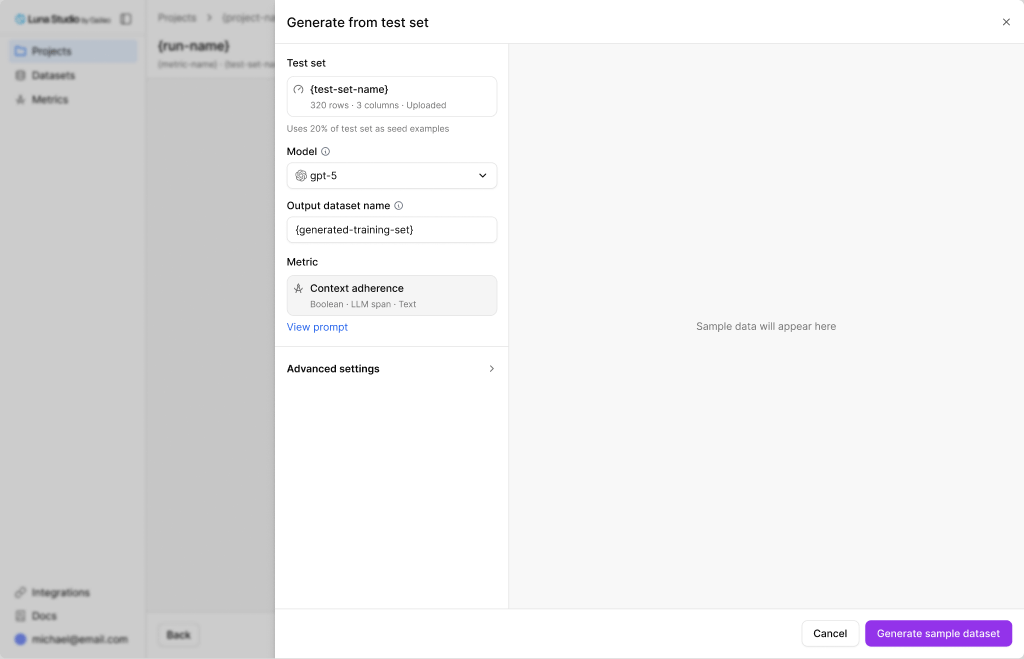
Generate from test set drawer, configure phase — pick a model and dataset name before generating samples
Click Generate sample dataset at the bottom of the drawer, once you are happy with the settings.
Review the sample data
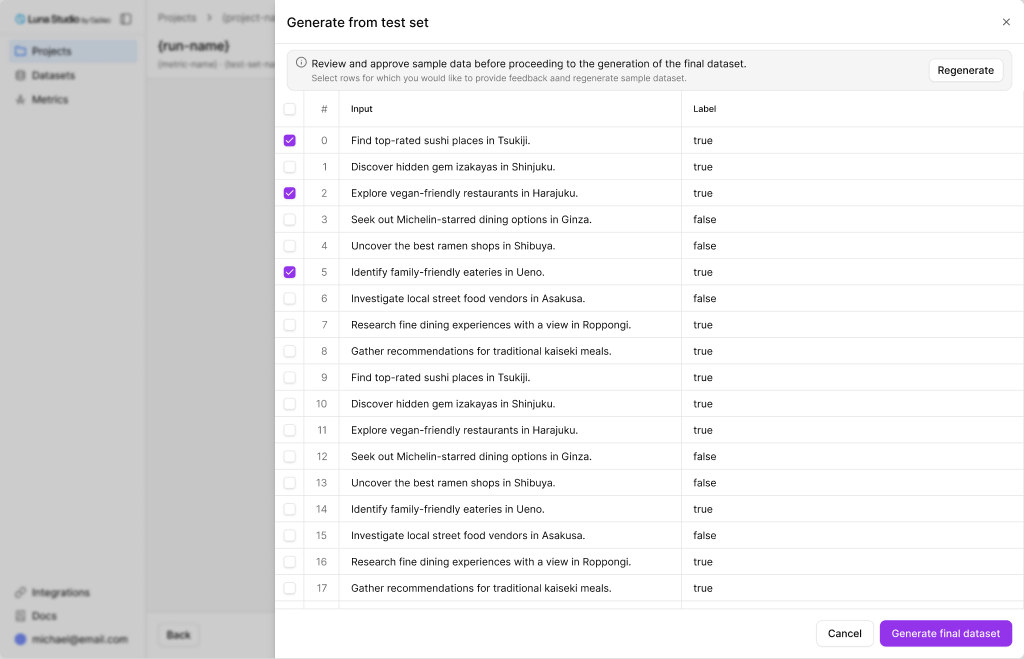
Generate from test set drawer, review phase — approve sample rows or regenerate before kicking off the full run
Provide feedback and Regenerate samples
You can provide feedback by selecting the rows that look wrong and clicking the Regenerate button. Once you click the button, the Regenerate dataset modal opens with a radio group of reasons:
Click Regenerate to kick off another sample generation.
The Regenerate button in the modal stays disabled until either a reason is picked or, for “Provide own feedback”, the text is non-empty.
Note: you can provide feedback up to three times. You can also track the cycles in the UI.
Generate the final dataset
Once you’re happy with the samples, the footer button changes to Generate final dataset. Clicking it creates the full 2,000-example training set. When it completes, the drawer closes and Step 3 shows the Training set completed view (see below).Add training logs
The Add training logs path uploads or imports your own production logs. Clicking the card opens the Add training set modal — the same generic dataset source modal used elsewhere in the app, with three sources:Upload from local
Drag-and-drop a
.csv or .jsonl file.Fetch from URL
Paste an
http://, https://, s3://, or gs:// URL.Import from Galileo
Browse datasets in your connected Galileo workspace.
Use existing training set
The Use existing training set path lets you pick a previously generated, labelled, or uploaded training dataset from this workspace without regenerating data or importing a new file.Validation
Luna Studio runs validation on the training set to ensure it meets the required schema / format / content rules. If there are any validation errors, they will be highlighted (See example below). For more details, see Validation.Training set completed
After either flow finishes, the step replaces the picker with a Selected dataset card and (if available) a preview table.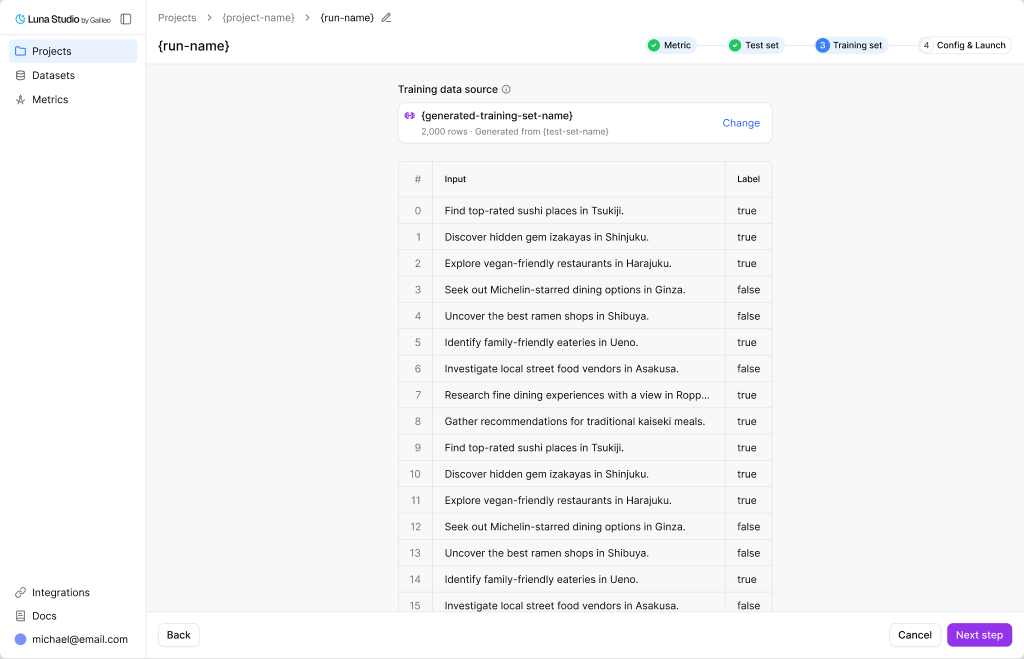
Step 3 once a training set is selected — the picker collapses into a card with a row preview
Where to go next
Step 4 — Config and launch
Pick a base model and launch.
Training sets reference
Schema, validation rules, and sources.